It's Not How Much Light
Ask most photographers about the light in a room and they will tell you whether there is enough of it. That is the wrong question. Quantity you can fix easily by opening the aperture, raising the ISO, or adding a lamp. The decision that actually shapes an image is not how much light there is. It is what kind.
Every light has a quality, and quality comes down to one physical fact: the size of the source relative to the subject. A small source like the bare sun or a single bare bulb throws light that arrives in nearly parallel rays. Shadows snap to a hard edge, texture stands up, and the mood feels unforgiving and graphic. A large source like an overcast sky or a big diffused panel wraps around the subject from many angles at once. The shadow edge softens into a gentle gradient, skin smooths out, and the mood turns quiet and kind.
That is the whole mechanism. Everything else, whether it is grids, flags, or scrims, is just a way of controlling those two variables: how big the source is and how far it sits from the subject. Move a softbox closer and it gets softer because, relative to the face, it just got larger. Pull it back and that same box hardens right up. The gear matters far less than the geometry.
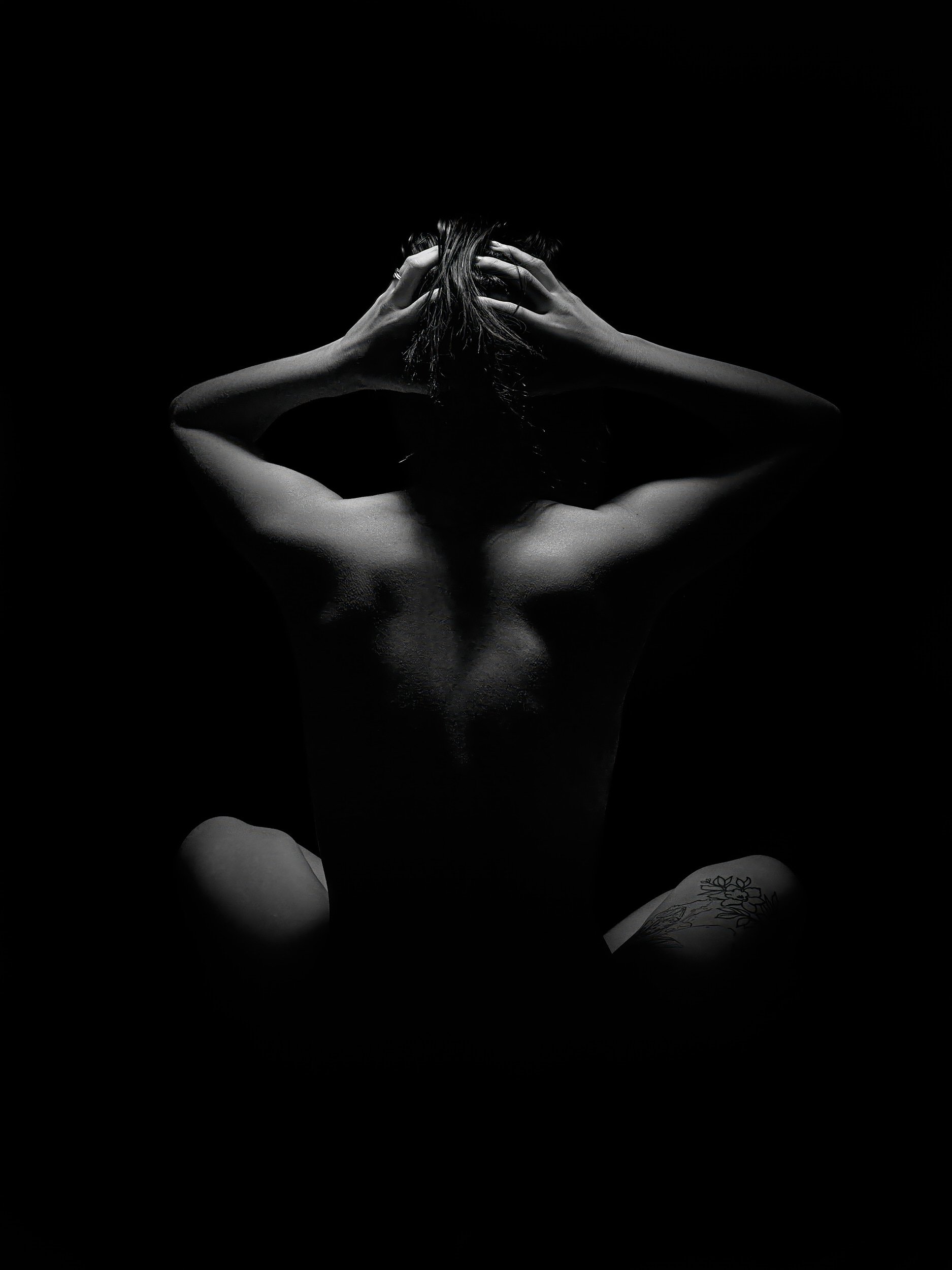
I have written before that I build images shadow first, meaning depth is a decision made before the light goes on rather than something recovered afterward. Quality of light is the other half of that equation. Where the shadow lives is your first choice, and how hard its edge falls is the next. A face lit hard from the side becomes pure architecture with striking planes and ridges. The same face under soft light becomes a quiet mood. Neither approach is better. They are simply different sentences, and the light is deciding which one you are writing.
Which is why asking what modifier to use is almost never the real question. The real question is what you want the edge of that shadow to feel like. Answer that honestly, and the equipment picks itself. I like to work hard and close, a single controlled source against a black field, because a crisp edge on a mostly-dark frame is where tension lives, and tension is usually what I'm after. But that's a choice, not a rule. On a different day, for a different face, the honest answer is a five-foot octabox and no drama at all.
People look at a frame like that and read the gradient rolling down the back as soft light. It isn't. That one was lit with a small seven-inch reflector a foot overhead, pointed straight down, about as hard and small as a source gets. Two different things get called a "gradient," and only one is about softness. A soft shadow edge, the blurred border of a cast shadow, comes from a big source. But the smooth falloff across a lit form is something else entirely: it's the light losing intensity as it wraps around curvature and drops away with distance, and a hard source pulled in close gives you the steepest version of it. The near planes stay crisp while the tone ramps fast into black. Hard light and a smooth gradient aren't opposites. Up close, on a curved body, you get both, and that pairing is most of what I'm after on a black field.
The photographers whose light I admire the most did not have better gear than the ones whose work falls flat. They simply decided what kind of light the picture needed before they turned anything on. That fundamental choice about hard or soft light is one of the few things in photography you genuinely cannot fix later. Your RAW file can rescue a messy exposure, but it will never soften a shadow that was carved hard, nor will it sharpen one that arrived soft. You are either choosing the quality of light in the room or you are just inheriting it.
So the next time you walk into a space to make a picture, do not ask whether there is enough light. Ask what the light is actually doing to the edges. That is where the photograph lives.