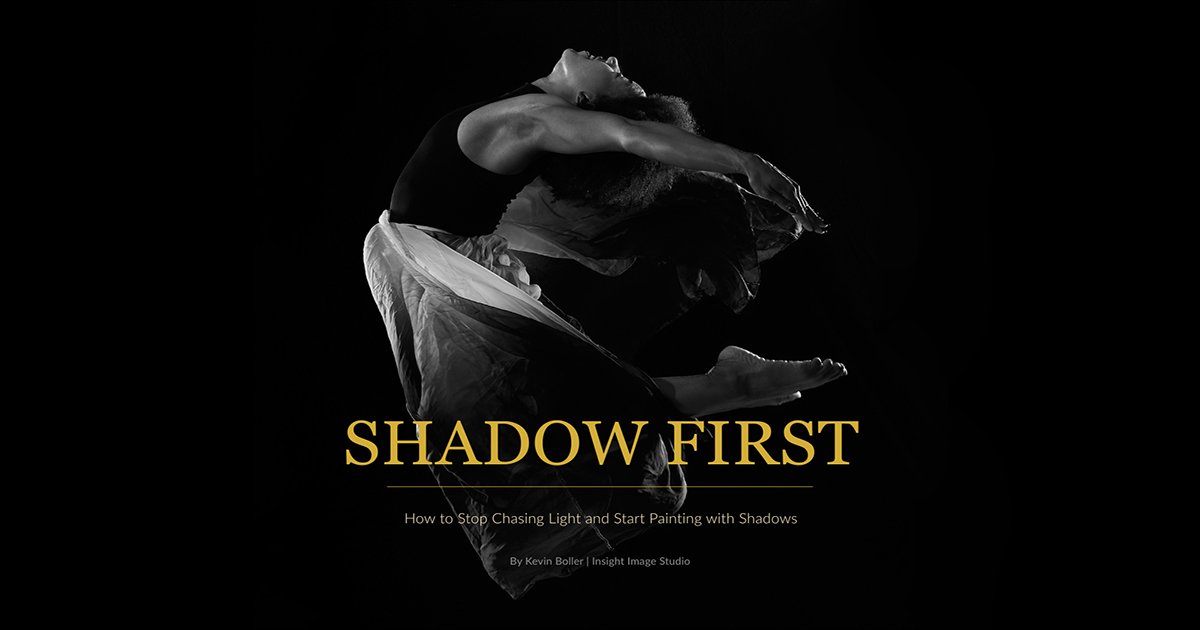
Shadow First is Here!
Why I Wrote Shadow First
The question I get more than any other isn't about gear. It isn't about settings or sync speeds or which modifier to use. It's simpler than that, and harder to answer.
How do you see light the way you do?
I've been asked that at workshops, by students, by photographers with better equipment than mine who can't figure out why their images come back flat. For a long time, I didn't have a good answer. I knew something was happening when I looked through the viewfinder — some internal calculus that felt obvious to me but apparently wasn't obvious to everyone — and I couldn't explain where it came from.
It took me years to figure out that it came from painting.
I picked up a camera at twelve years old, but I was also a painter and a traditional artist. Studying the craft. Spending more time than I'd admit looking at Caravaggio's The Calling of Saint Matthew — not because someone assigned it, but because I couldn't stop looking at that light. That spotlight cutting through a dark tavern and landing on one outstretched hand. I wasn't thinking about photography. I was just absorbing what it felt like when light meant something.
That absorption was happening in parallel with my photography for years, and I didn't realize the two were connected. I didn't know I was building a framework. I thought I was just in love with painters.
Here's what I eventually understood: the old masters were solving the same problem photographers solve. They were trying to create the illusion of three-dimensional reality on a flat surface. Every mark they made about light and shadow was a decision about depth and form. Da Vinci mapped the physics of how light decays into darkness. Caravaggio proved that restricting light creates more authority than flooding a scene. Rembrandt found the transition zone — that specific gradient where highlight gives up and shadow begins — and understood that's where a face stops being a flat surface and starts carrying a life. Degas decided some things should stay in shadow on purpose, and that the most honest image sometimes looks like you almost missed it.
Four centuries of figured-out problems. Sitting right there. Available to any photographer willing to look at them as photographers and not just as art history.
The reason I wrote Shadow First is that I got tired of watching technically excellent photographers produce flat work. Not bad work — technically sharp, well-exposed, properly composed work that somehow had no atmosphere, no weight, nothing that made you want to lean in. And the standard advice — "get better at post-processing" — was making it worse. Every hour spent trying to inject mood into a flat RAW file is an hour compensating for a decision that wasn't made before the shutter fired. The depth isn't there because nobody decided where the shadow was going to live before the light went on.
This guide is what I found when I finally looked back at my own instincts and traced them to their source. It's not a curriculum anyone handed me. It's a framework I reverse-engineered from my own seeing — built on foundations that predate photography by four hundred years.
If it helps you see what you couldn't see before, that's enough.