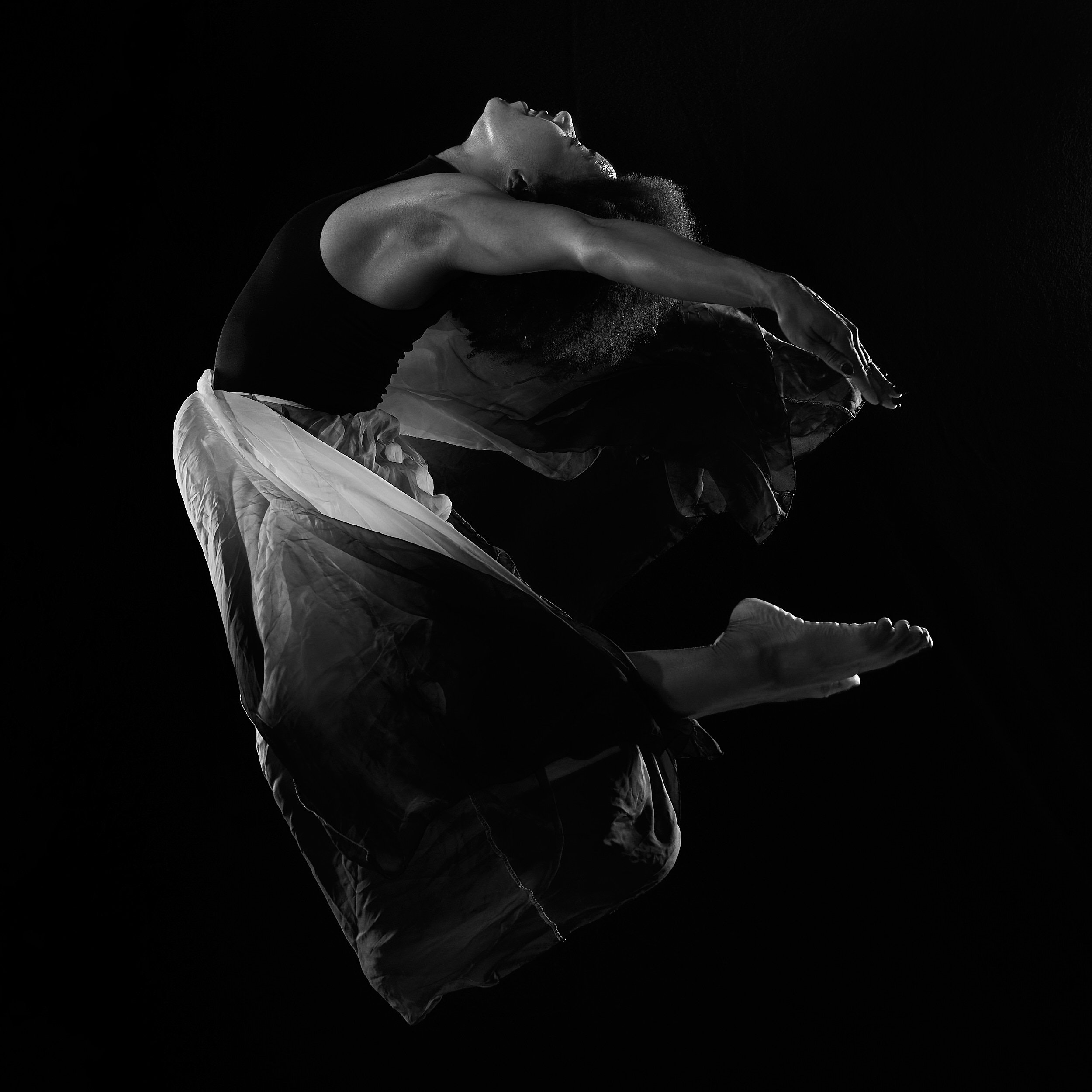
Evidence of Intent
A dancer in motion is almost impossible to photograph honestly. Not because the shutter is too slow — because there is too much of it. A body crossing a room offers a thousand shapes a second, and most of them are transitions: an arm on its way somewhere, weight that hasn't arrived yet. Point a camera at that and you get documentation. Proof that dancing happened.
The Tiffany Study is built on a narrower question. Out of all those shapes, which single one is the statement — the exact frame where movement stops being dance and becomes an argument about the human form? Everything else in the series was removed to make room for that question. No stage. No choreography for the viewer to follow. No narrative to lean on. A controlled black field, and a body reduced to the fundamental elements of its own physical language.
I've written before that I build images shadow first — that the depth in a photograph is decided before the light goes on, not recovered afterward from a RAW file. The Tiffany Study is what that principle looks like taken to its edge. The black here isn't a backdrop; it's most of the composition. I gave the frame almost nothing to hold, so that the one thing left — a line of tension through a shoulder, a hand caught at the top of its arc — has nowhere to hide.
That kind of subtraction sounds simple. It isn't. Nineteen years as a data scientist taught me one thing that transferred completely to this work: the hard part is never gathering signal, it's deciding what to discard. A frame with too much in it is the photographic version of an over-fit model — it accounts for everything and means nothing. So the work on these images was mostly the work of removal. Strip the environment. Strip the story. Strip every frame where the body is on its way somewhere instead of arrived. What survives isn't a picture of a dance. It's evidence of intent.
The four frames came out of that same discipline. Echo of the Plea and The Anatomy of a Plea are two readings of one gesture — one the feeling, the other the structure underneath it. The Kinetic Arc is the frame where an entire movement's energy resolves into a single curved line. The Physics of Grace is the one I'm still not done thinking about: grace reads as effortless, but it's a precise negotiation with gravity, and a camera can catch the negotiation if you wait for the right hundredth of a second.
A study reduced this far only holds if the person in front of the camera can carry it. Tiffany and I had been talking about working together for almost a year before our schedules finally lined up, and it was worth the wait — one of the best collaborations I've had with talent at that level. The division of labor was clean: she owned the movement and every position it passed through, which freed me to concentrate entirely on the light and the thinking behind each frame. That's the quiet argument underneath the whole series. These images aren't a record of what a dancer can do; they're the handful of moments, chosen out of everything a body can do in a black room, that still mean something once the music, the motion, and the context are stripped away.
The Tiffany Study is groundwork. It's where I worked out the visual grammar for Thresholds, the series it leads into. But it stands on its own, too — as the clearest statement I've made about what I actually photograph. Not movement. The instant movement decides what it is.